Jasper County, Illinois | Post-Frame Construction & Metal Buildings
Around Jasper County
The Jasper County Fair is a centerpiece of the local calendar. The 154th fair runs from June 21-27, 2026. Its schedule reflects the county’s agricultural and equestrian interests, with horse racing on Monday and Tuesday, the Whippoorwill Rodeo on Wednesday, a non-sanctioned tractor and truck pull on Thursday, and the ITPA Tractor Pull on Saturday. Those activities make practical farm storage, horse buildings, and flexible gathering space relevant here.
Sam Parr State Park offers more than 2 miles of foot trails and 13 miles of equestrian trails. It is also a strong birding destination, with over 200 species that include waterfowl and songbirds. For horse owners, those equestrian trails make secure space for tack, feed, trailers, and stalls especially useful.
At Newton Lake State Fish and Wildlife Area, the lake is open year-round except during the regular firearm deer seasons. A 25 h.p. motor is the maximum allowed on the lake. A property owner who spends time there may want covered space at home for a fishing boat, motor, trailer, and outdoor equipment rather than leaving them exposed between trips.
Newton is home to the Drive ’n Theatre, formerly the Fairview Drive-In, which opened in 1953. It is one of the last remaining drive-in theaters, alongside community recreation that includes an aquatic center and skate park.
The Jasper County Museum preserves historic and cultural items from people across the county. It officially opened to the public in the summer of 1966. One of the county’s more unusual stories comes from Newton, where a post office was established in March of 1883 not in a building, but in a man’s hat.
Energy production is also part of Jasper County’s working identity. Illinois Power Generating Co operates a large coal-fired power plant in Newton. The Newton Plant, southwest of the city, was constructed as an electric generating facility with two generators capable of producing approximately 1,180,000 kilowatts when operating simultaneously. That industrial presence sits alongside construction, transportation, warehousing, wholesale trade, retail, food service, and other local businesses.
Building on Jasper County Soil
Drainage deserves early attention on a Jasper County building site. Across the county, 82.9 percent of the land is poorly drained. Cisne is a dominant soil, with Bluford also common. In plain terms, water may leave some properties slowly after rain, so choosing the building location is about more than finding a level-looking patch of ground.
For a post-frame building, standing water around posts or beneath the floor can create long-term trouble. Thoughtful grading should move water away from the structure instead of allowing it to collect along the walls. A properly prepared gravel base can help create a stable, workable surface, while the building should be positioned where runoff can be managed. Built-Mor Buildings can discuss the intended use and site layout with the property owner, but actual conditions still need to be evaluated at the chosen location.
What People Build in Jasper County
Machine Storage fits a county where tractor pulls are part of the fair schedule and where property owners need protected room for tractors, implements, and maintenance equipment. A wide post-frame layout can make it easier to arrange machinery without filling the building with interior obstructions.
Stall Barn space has a clear local connection to the horse racing, rodeo, and 13 miles of equestrian trails at Sam Parr State Park. The layout can be planned around stalls, feed, tack, and circulation rather than treating horse care as an afterthought.
Residential Vehicle Storage can serve people using Newton Lake. Covered space keeps a boat, motor, and trailer together at home, with room for fishing and outdoor gear.
Recreational Buildings make sense in a county with youth soccer, youth basketball, an aquatic center, a skate park, and a busy fair calendar. A flexible post-frame building can provide open indoor space for practice, activities, equipment, or community use.
Office or Warehouse buildings fit the local presence of wholesale trade, construction, transportation, and warehousing. Access to Illinois Route 33, Illinois Route 49, and Illinois Route 130 can also matter when planning vehicle movement, deliveries, and storage.
Retail & Restaurant buildings connect directly to Jasper County’s local retail and food-service businesses. Built-Mor Buildings can plan a metal or post-frame shell around customer areas, back-of-house space, storage, and the property’s available footprint.
One Built-Mor customer put it simply: “20 years old ,still satisfied, looks as good as it did when built” (Ron W., Google review).
Towns Served in Jasper County
Built-Mor Buildings serves property owners in Newton, Ste. Marie, Willow Hill, Hidalgo, Wheeler, Rose Hill, Yale, and West Liberty.
Planning a Building in Jasper County
A useful first conversation starts with what must fit inside. That may include machinery dimensions, a boat and trailer, horse stalls, workshop benches, inventory, customer space, or a combination of uses. Door locations, clear interior room, traffic flow, and future storage needs are easier to address before the building footprint is fixed.
The site matters just as much as the floor plan. In Jasper County, drainage, grading, gravel preparation, and the route water takes after a storm should be considered from the beginning. Access from the road, room for delivery and daily vehicle movement, and a sensible position on the property all affect how well the finished building works.
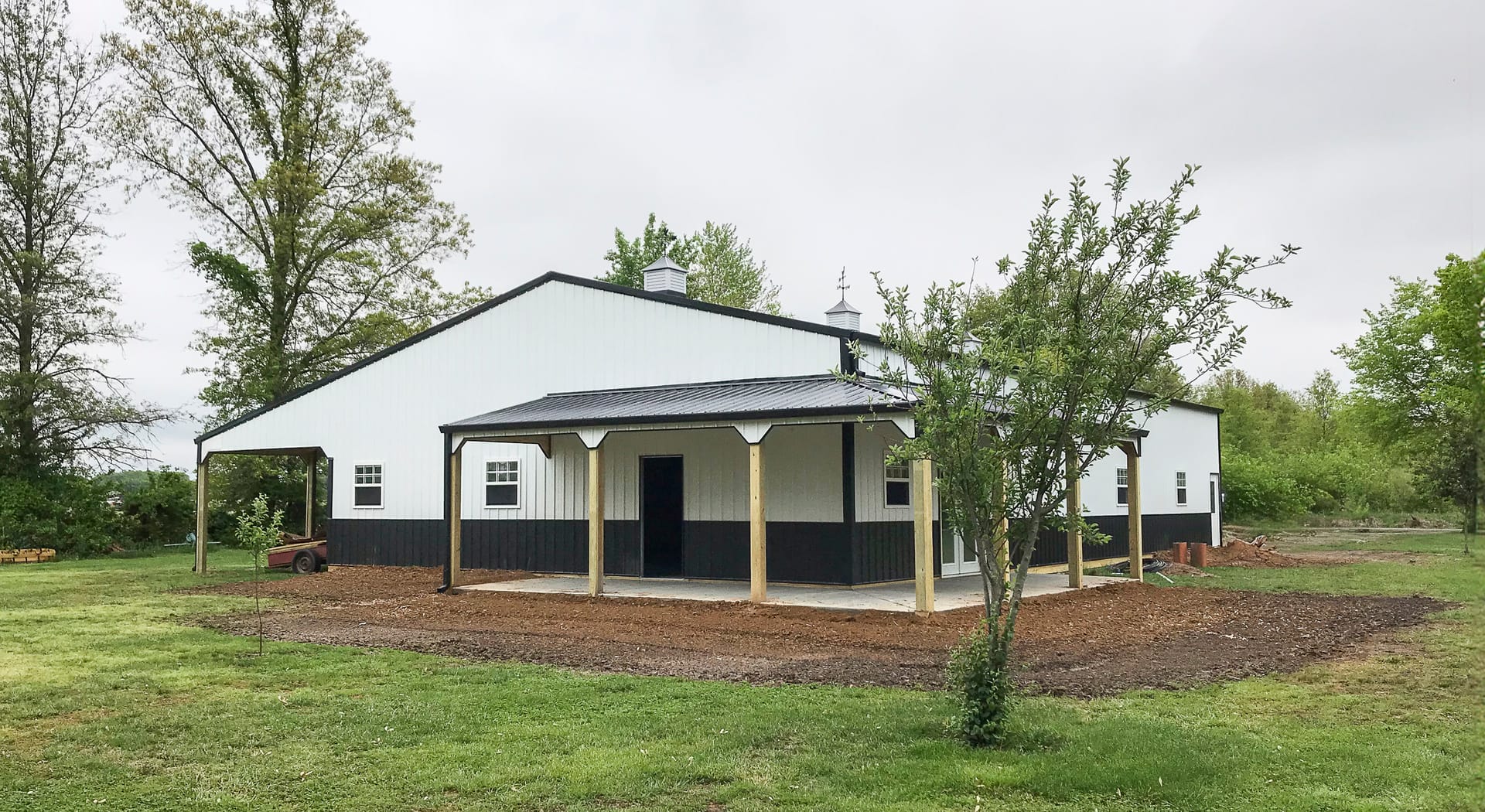
Built-Mor Buildings works with Jasper County property owners on pole barns, barndominiums, and custom post-frame or metal buildings shaped around the site and the job the building needs to do.
Post-Frame Construction in Southern Illinois
What soil conditions in Southern Illinois affect pole barn construction?▼
Southern Illinois has variable soil conditions ranging from clay-heavy bottomland near rivers to well-drained loess soils on uplands. Clay soils require deeper post embedment or concrete piers to prevent frost heave. Built-Mor evaluates your site and engineers the foundation appropriately — posts are typically set 4 to 6 feet deep depending on soil type and building size.
What snow load requirements apply to pole barns in Southern Illinois?▼
Southern Illinois is in a 20-25 pound per square foot ground snow load zone under Illinois building codes. Built-Mor engineers all structures to meet or exceed local snow load requirements. Roof pitch, truss spacing, and lumber grades are specified based on your county's requirements and the intended use of the building.
Do I need a permit for a pole barn in Southern Illinois?▼
Most Southern Illinois counties require building permits for pole barns and post-frame structures. Requirements vary by county — some have size thresholds, others require permits for any permanent structure. The owner obtains the building permit, and Built-Mor provides the plans to take to the city or county. We know the requirements in each county we serve.
How do Southern Illinois weather conditions affect post-frame buildings?▼
Southern Illinois experiences hot, humid summers and cold winters with occasional ice storms. Post-frame buildings handle these conditions well when properly engineered. Built-Mor specifies pressure-treated posts rated for ground contact, appropriate ventilation for humidity control, and steel roofing and siding that withstand temperature swings and severe weather.
What areas does Built-Mor serve in Southern Illinois?▼
Built-Mor Buildings serves all of Southern Illinois, from the Metro East (St. Clair, Madison counties) south to Massac and Pulaski counties, and east to the Indiana border. We are a local contractor based in Southern Illinois — not a national kit company. We build complete structures on your site.